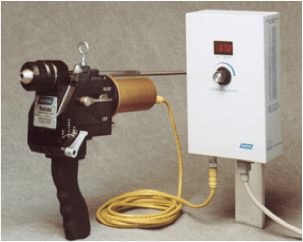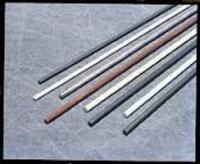
How ROKIDE® ceramic spray coatings reduce costs The ROKIDE® Process−Ceramic rods are melted, atomized and sprayed at high velocity (550 ft./sec., 170 m/ sec.) onto metal or nonmetallic surfaces. This forms a hard, chemically inert coating that can be left as is or ground to a specified tolerance. ROKIDE® rods are available in many ceramic oxide compositions for a wide range of applications. ROKIDE® rods are sprayed through portable ROKIDE® spray units driven by electricity. These are some of the ways ROKIDE® coatings can help deliver substantial savings, improving the profitability of your business: 1. Wear resistance−ROKIDE® ceramic coatings are much harder and far more resistant to wear and abrasion than metals, making them ideal for pump components like sleeves, plungers, impellers and casings. ROKIDE multiplies service life for applications where the fluid being pumped contains sand, dirt or other abrasive particles. This reduces downtime for maintenance and greatly increases productivity. 2. Thermal barrier coatings− Some ROKIDE coatings provide a thermal barrier to protect the underlying substrate. Thus, ROKIDE coated components enhance metal with the protective properties of ceramic at temperatures up to 4500°F (2480°C) in rocket engine exhausts and jet engine components. Since ROKIDE coatings provide both wear resistance and heat resistance, they are ideal for hot extrusion dies or components in contact with molten metal. 3. Electrical insulation− Certain ROKIDE ceramic coatings offer superior insulating properties for parts used in electrical components. ROKIDE can be used in wire-wound furnace cores and copper induction heating coils for both heat and electrical insulation. 4. Corrosion resistance− Ceramics are chemically inert, even in the presence of many corrosive chemicals. This makes specific ROKIDE coatings ideal for chemical and process industry applications where metals can be attacked by the product being manufactured. Metal impellers or mixer blades coated with ROKIDE are as inert as many plastics, yet they possess the required structural strength that plastic components often lack. The combination of heat resistance and corrosion resistance makes ROKIDE coated metals ideal for many environmental applications in hostile environments. 5. Weight reduction− In applications where weight is critical, ROKIDE coatings often make a crucial contribution. A component made of steel for its heat and wear resistance can in some cases be engineered to utilize an alternative substrate coated with ROKIDE. 6. Material cost savings− Most ROKIDE coatings can give "super" properties to relatively inexpensive materials. A pump body made of expensive stainless steel can in some cases be replaced by less expensive cast iron and coated internally with ROKIDE to protect against corrosive or abrasive fluids. Value engineering can turn up numerous opportunities to reduce operating costs. 7. Reconditioning worn parts− The expense of replacing worn parts can be greatly reduced, and in some cases eliminated with ROKIDE coatings. A component is metal-sprayed to build up the worn area, then given a ROKIDE coating and ground to tolerance before reinstallation. Parts can often be reconditioned on location, saving the costs of removing, transporting and reinstalling. How ROKIDE® coatings are applied The surface to be coated is given an initial grit or pressure blasting with aluminum oxide to clean and roughen it. For proper roughening, the surface should have a hardness less than Rockwell C−50. This assures maximum adherence of the ceramic coating that may range from .005" (.127 mm) to 0.060 (1.6 mm) thick. Grit blasting is followed with a nickel chrome or other undercoat for increased bond strength and to minimize problems associated with the differential of thermal expansion between metals and ceramics. The base material should be able to withstand coating temperatures of 200-350°F (90-175°C). Finishing ROKIDE® coatings ROKIDE coated surfaces can be ground to excellent surface finishes. They can be ground to as low as 2 to 4 RA using standard grinding equipment with properly specified silicon carbide or diamond grinding wheels. Flatness readings of less than 3 helium light bands are achievable using standard industrial lapping equipment. Complete information on proper ceramic grinding and lapping techniques can be provided. Composite coatings ROKIDE ceramic coatings, in conjunction with metal spray coatings, can be applied to metals to form a metal/ ceramic composite with a controlled thermal gradient. This technique has proven successful in producing composites with varying heat transfer and insulation characteristics required for such applications as underwater plastic extrusion dies. Impregnating ROKIDE® coatings For special applications where enhanced electrical or corrosion resistant properties are required, impregnants can be used to fill the 1-2 micron pores of some ROKIDE coatings. Epoxy, phenolic, polyester and silicone resin sealants have been used successfully. |